
Java Collection Framework
What is Collections Framework?
Section titled “What is Collections Framework?”- Unified architecture for representing and manipulating collections
- Reduces programming effort by providing data structures and algorithms
- Increases performance with high-performance implementations
- Promotes reuse - interoperable collections API
Key Benefits
Section titled “Key Benefits”graph TB
A[Collections Framework] --> B[Reduces Programming Effort]
A --> C[Increases Performance]
A --> D[Promotes Reuse]
A --> E[Reduces Learning Effort]
Hierarchy Overview
Section titled “Hierarchy Overview”// Basic collection usage exampleList<String> list = new ArrayList<>();Set<Integer> set = new HashSet<>();Map<String, Integer> map = new HashMap<>();Core Collection Interfaces
Section titled “Core Collection Interfaces”Collection Interface
Section titled “Collection Interface”- Root interface of collection hierarchy
- Basic operations: add, remove, contains, size, etc.
- Bulk operations: addAll, removeAll, retainAll
- Array operations: toArray()
Collection<String> collection = new ArrayList<>();collection.add("Apple");collection.add("Banana");collection.remove("Apple");System.out.println(collection.size()); // 1Iterable Interface
Section titled “Iterable Interface”- Enables for-each loops
- Provides Iterator for sequential access
- Default methods: forEach
List<String> fruits = Arrays.asList("Apple", "Banana", "Cherry");for (String fruit : fruits) { System.out.println(fruit);}Iterator vs ListIterator
Section titled “Iterator vs ListIterator”- Iterator: Forward traversal only, remove operation
- ListIterator: Bidirectional, add/set operations
List<String> list = new ArrayList<>();ListIterator<String> iterator = list.listIterator();while (iterator.hasNext()) { String element = iterator.next(); iterator.set(element.toUpperCase());}List Implementations
Section titled “List Implementations”ArrayList
Section titled “ArrayList”- Resizable array implementation
- Fast random access - O(1)
- Slow insertions/deletions in middle - O(n)
- Not synchronized
List<String> arrayList = new ArrayList<>();arrayList.add("Element1");arrayList.add(0, "Element0"); // Add at indexString element = arrayList.get(1); // Fast accessLinkedList
Section titled “LinkedList”- Doubly-linked list implementation
- Fast insertions/deletions - O(1)
- Slow random access - O(n)
- Implements Queue interface
List<String> linkedList = new LinkedList<>();linkedList.add("First");linkedList.add("Last");linkedList.add(1, "Middle"); // Efficient insertionVector vs ArrayList
Section titled “Vector vs ArrayList”graph LR
A[Vector] --> B[Synchronized]
A --> C[Thread-safe]
D[ArrayList] --> E[Not Synchronized]
D --> F[Better Performance]
Vector<String> vector = new Vector<>(); // SynchronizedList<String> arrayList = new ArrayList<>(); // Not synchronizedList<String> syncList = Collections.synchronizedList(arrayList); // Make synchronizedPerformance Comparison
Section titled “Performance Comparison”| Operation | ArrayList | LinkedList |
|---|---|---|
| get(index) | O(1) | O(n) |
| add(element) | O(1) amortized | O(1) |
| add(index, element) | O(n) | O(1) |
| remove(index) | O(n) | O(1) |
Set Implementations
Section titled “Set Implementations”HashSet
Section titled “HashSet”- Hash table implementation
- No ordering guaranteed
- Constant time operations - O(1)
- Permits null elements
Set<String> hashSet = new HashSet<>();hashSet.add("Apple");hashSet.add("Banana");hashSet.add("Apple"); // Duplicate ignoredSystem.out.println(hashSet.size()); // 2LinkedHashSet
Section titled “LinkedHashSet”- Hash table + linked list
- Maintains insertion order
- Slightly slower than HashSet
- Predictable iteration order
Set<String> linkedHashSet = new LinkedHashSet<>();linkedHashSet.add("Zebra");linkedHashSet.add("Apple");linkedHashSet.add("Banana");// Iteration order: Zebra, Apple, BananaTreeSet
Section titled “TreeSet”- Red-Black tree implementation
- Elements sorted in natural order
- Logarithmic time operations - O(log n)
- Implements NavigableSet
Set<String> treeSet = new TreeSet<>();treeSet.add("Orange");treeSet.add("Apple");treeSet.add("Banana");// Sorted order: Apple, Banana, OrangeSet Characteristics
Section titled “Set Characteristics”graph TB
A[Set Implementations] --> B[HashSet: Unordered]
A --> C[LinkedHashSet: Insertion Order]
A --> D[TreeSet: Sorted Order]
B --> E[Fastest Operations]
C --> F[Ordered + Fast]
D --> G[Sorted + Slower]
Queue Implementations
Section titled “Queue Implementations”Queue Interface
Section titled “Queue Interface”- Designed for holding elements prior to processing
- FIFO (First-In-First-Out) typically
- Core operations: offer, poll, peek
Queue<String> queue = new LinkedList<>();queue.offer("First");queue.offer("Second");queue.offer("Third");
while (!queue.isEmpty()) {    System.out.println(queue.poll()); // First, Second, Third}
PriorityQueue
Section titled “PriorityQueue”- Elements ordered by natural ordering or comparator
- No null elements allowed
- Head is least element according to ordering
Queue<Integer> pq = new PriorityQueue<>();pq.offer(5);pq.offer(1);pq.offer(3);
while (!pq.isEmpty()) {    System.out.println(pq.poll()); // 1, 3, 5 (sorted order)}
Deque Interface
Section titled “Deque Interface”- Double ended queue
- Supports insertion/removal at both ends
- Can be used as LIFO stack
Deque<String> deque = new ArrayDeque<>();deque.offerFirst("Front");deque.offerLast("End");deque.pollFirst(); // Remove frontQueue Types Comparison
Section titled “Queue Types Comparison”// Regular Queue - FIFOQueue<String> queue = new LinkedList<>();
// Priority Queue - SortedQueue<String> priorityQueue = new PriorityQueue<>();
// Deque - Double endedDeque<String> deque = new ArrayDeque<>();
// Stack behavior using DequeDeque<String> stack = new ArrayDeque<>();stack.push("Element"); // LIFOMap Implementations
Section titled “Map Implementations”HashMap
Section titled “HashMap”- Hash table based implementation
- No ordering guarantees
- Permits one null key and multiple null values
- Constant time performance for basic operations
Map<String, Integer> hashMap = new HashMap<>();hashMap.put("Apple", 1);hashMap.put("Banana", 2);hashMap.put("Cherry", 3);
Integer value = hashMap.get("Apple"); // 1boolean exists = hashMap.containsKey("Banana"); // true
LinkedHashMap
Section titled “LinkedHashMap”- Maintains insertion order
- Slower iteration than HashMap
- Useful for LRU caches
Map<String, Integer> linkedHashMap = new LinkedHashMap<>();linkedHashMap.put("Zebra", 1);linkedHashMap.put("Apple", 2);linkedHashMap.put("Banana", 3);// Iteration order: Zebra, Apple, BananaTreeMap
Section titled “TreeMap”- Red-Black tree implementation
- Sorted according to natural ordering
- Logarithmic time cost for operations
Map<String, Integer> treeMap = new TreeMap<>();treeMap.put("Orange", 1);treeMap.put("Apple", 2);treeMap.put("Banana", 3);// Keys sorted: Apple, Banana, OrangeHashtable vs HashMap
Section titled “Hashtable vs HashMap”graph LR
A[Hashtable] --> B[Synchronized]
A --> C[Legacy Class]
A --> D[No Null Keys/Values]
E[HashMap] --> F[Not Synchronized]
E --> G[Modern Replacement]
E --> H[Allows One Null Key]
// Legacy - synchronizedHashtable<String, Integer> hashtable = new Hashtable<>();
// Modern - not synchronizedHashMap<String, Integer> hashMap = new HashMap<>();
// Thread-safe versionMap<String, Integer> syncMap = Collections.synchronizedMap(hashMap);
Map Operations
Section titled “Map Operations”Map<String, Integer> map = new HashMap<>();
// Basic operationsmap.put("Key", 100);map.get("Key"); // 100map.remove("Key");
// Bulk operationsmap.putAll(anotherMap);map.clear();
// Collection viewsSet<String> keys = map.keySet();Collection<Integer> values = map.values();Set<Map.Entry<String, Integer>> entries = map.entrySet();Utility Classes
Section titled “Utility Classes”Collections Class
Section titled “Collections Class”- Static methods for collection operations
- Algorithms: sort, shuffle, reverse, rotate
- Wrapper methods: synchronized, unmodifiable
List<String> list = new ArrayList<>();Collections.addAll(list, "C", "A", "B");
// SortingCollections.sort(list); // [A, B, C]
// Searchingint index = Collections.binarySearch(list, "B"); // 1
// Synchronized wrapperList<String> syncList = Collections.synchronizedList(list);
Arrays Class
Section titled “Arrays Class”- Utility methods for array manipulation
- Conversion between arrays and collections
- Sorting and searching arrays
String[] array = {"Apple", "Banana", "Cherry"};
// SortingArrays.sort(array);
// Binary searchint index = Arrays.binarySearch(array, "Banana");
// Convert to listList<String> list = Arrays.asList(array);
Common Utility Methods
Section titled “Common Utility Methods”// Collections utilitiesList<Integer> numbers = Arrays.asList(3, 1, 4, 1, 5);Collections.sort(numbers);Collections.reverse(numbers);Collections.shuffle(numbers);Collections.fill(numbers, 0);
// Arrays utilitiesint[] arr = {5, 2, 8, 1};Arrays.sort(arr);Arrays.fill(arr, 10);int[] copy = Arrays.copyOf(arr, arr.length);Sorting and Comparison
Section titled “Sorting and Comparison”Comparable Interface
Section titled “Comparable Interface”- Natural ordering of objects
- Single sorting sequence
- compareTo method implementation
class Person implements Comparable<Person> {    String name;    int age;
    @Override    public int compareTo(Person other) {        return this.name.compareTo(other.name);    }}
List<Person> people = new ArrayList<>();Collections.sort(people); // Uses natural ordering
Comparator Interface
Section titled “Comparator Interface”- Multiple sorting sequences
- Flexible comparison logic
- compare method implementation
// Sort by ageComparator<Person> ageComparator = new Comparator<Person>() {    @Override    public int compare(Person p1, Person p2) {        return Integer.compare(p1.age, p2.age);    }};
// Sort by name lengthComparator<Person> nameLengthComparator =    (p1, p2) -> Integer.compare(p1.name.length(), p2.name.length());
Collections.sort(people, ageComparator);
Java 8+ Comparison Enhancements
Section titled “Java 8+ Comparison Enhancements”List<Person> people = new ArrayList<>();
// Method referencespeople.sort(Comparator.comparing(Person::getName));people.sort(Comparator.comparing(Person::getAge).reversed());
// Multiple criteriapeople.sort(Comparator .comparing(Person::getLastName) .thenComparing(Person::getFirstName));
// Null friendlypeople.sort(Comparator.comparing(Person::getName, Comparator.nullsLast(String::compareTo)));Best Practices
Section titled “Best Practices”Collection Selection Guide
Section titled “Collection Selection Guide”graph TD
A[Choose Collection Type] --> B{Need Duplicates?}
B -->|No| C{Need Ordering?}
B -->|Yes| D[List Implementation]
C -->|No| E[HashSet]
C -->|Insertion Order| F[LinkedHashSet]
C -->|Sorted| G[TreeSet]
D --> H{Access Pattern?}
H -->|Random Access| I[ArrayList]
H -->|Frequent Insert/Delete| J[LinkedList]
Memory and Performance
Section titled “Memory and Performance”- ArrayList: Good for read-heavy, random access
- LinkedList: Good for frequent insertions/deletions
- HashSet: Fastest set operations, unordered
- TreeSet: Slower but sorted
- HashMap: General purpose mapping
Thread Safety
Section titled “Thread Safety”// Not thread-safeList<String> unsafeList = new ArrayList<>();
// Synchronized wrapperList<String> syncList = Collections.synchronizedList(new ArrayList<>());
// Concurrent collections (Java 5+)ConcurrentHashMap<String, Integer> concurrentMap = new ConcurrentHashMap<>();CopyOnWriteArrayList<String> copyOnWriteList = new CopyOnWriteArrayList<>();Common Pitfalls and Solutions
Section titled “Common Pitfalls and Solutions”// 1. Concurrent ModificationList<String> list = new ArrayList<>();// WRONG: for (String item : list) { list.remove(item); }// RIGHT: Use Iterator.remove()Iterator<String> iterator = list.iterator();while (iterator.hasNext()) { String item = iterator.next(); iterator.remove();}
// 2. Proper equals() and hashCode()class Student { String id;
@Override public boolean equals(Object o) { if (this == o) return true; if (!(o instanceof Student)) return false; Student student = (Student) o; return Objects.equals(id, student.id); }
@Override public int hashCode() { return Objects.hash(id); }}
// 3. Choosing right initial capacityList<String> list = new ArrayList<>(1000); // Avoid resizingMap<String, Integer> map = new HashMap<>(16, 0.75f); // Initial capacity, load factorJava 8+ Features
Section titled “Java 8+ Features”// Streams with collectionsList<String> filtered = list.stream() .filter(s -> s.startsWith("A")) .collect(Collectors.toList());
// Map operationsmap.computeIfAbsent("key", k -> calculateValue(k));map.merge("key", 1, Integer::sum);
// Collection factories (Java 9+)List<String> immutableList = List.of("A", "B", "C");Set<Integer> immutableSet = Set.of(1, 2, 3);Map<String, Integer> immutableMap = Map.of("A", 1, "B", 2);Java Collections Framework With Diagrams
Section titled “Java Collections Framework With Diagrams”1. Collections Framework Hierarchy
Section titled “1. Collections Framework Hierarchy”
2. Collection Interface Hierarchy
Section titled “2. Collection Interface Hierarchy”classDiagram
Iterable <|-- Collection
Collection <|-- List
Collection <|-- Set
Collection <|-- Queue
Queue <|-- Deque
class Iterable {
<<interface>>
+iterator() Iterator
+forEach(Consumer) void
}
class Collection {
<<interface>>
+add(E) boolean
+remove(Object) boolean
+contains(Object) boolean
+size() int
+isEmpty() boolean
+toArray() Object[]
}
class List {
<<interface>>
+get(int) E
+set(int, E) E
+add(int, E) void
+remove(int) E
+indexOf(Object) int
}
class Set {
<<interface>>
// No duplicate elements
}
class Queue {
<<interface>>
+offer(E) boolean
+poll() E
+peek() E
}
class Deque {
<<interface>>
+offerFirst(E) boolean
+offerLast(E) boolean
+pollFirst() E
+pollLast() E
}
style Iterable fill:#0d47a1
style Collection fill:#0d47a1
style List fill:#1a237e
style Set fill:#1a237e
style Queue fill:#1a237e
style Deque fill:#1a237e
3. List Implementations Comparison
Section titled “3. List Implementations Comparison”
4. Set Implementations Characteristics
Section titled “4. Set Implementations Characteristics”
5. Map Interface Hierarchy
Section titled “5. Map Interface Hierarchy”classDiagram
Map <|-- SortedMap
Map <|-- ConcurrentMap
SortedMap <|-- NavigableMap
class Map {
<<interface>>
+put(K, V) V
+get(K) V
+remove(K) V
+containsKey(K) boolean
+keySet() Set~K~
+values() Collection~V~
+entrySet() Set~Entry~K,V~~
}
class SortedMap {
<<interface>>
+firstKey() K
+lastKey() K
+headMap(K) SortedMap
+tailMap(K) SortedMap
}
class NavigableMap {
<<interface>>
+lowerKey(K) K
+higherKey(K) K
+floorKey(K) K
+ceilingKey(K) K
}
class ConcurrentMap {
<<interface>>
+putIfAbsent(K, V) V
+remove(K, V) boolean
+replace(K, V) V
}
style Map fill:#1a237e
style SortedMap fill:#1a237e
style NavigableMap fill:#1a237e
style ConcurrentMap fill:#1a237e
6. Map Implementations Decision Tree
Section titled “6. Map Implementations Decision Tree”flowchart TD
A[Choose Map Implementation] --> B{Need Sorting?}
B -->|Yes| C[TreeMap<br/>Red-Black Tree<br/>Sorted Keys]
B -->|No| D{Need Insertion Order?}
D -->|Yes| E[LinkedHashMap<br/>Hash Table + Linked List<br/>Insertion Order]
D -->|No| F{Thread Safety Required?}
F -->|Yes| G[ConcurrentHashMap<br/>Thread-Safe<br/>Better Performance]
F -->|No| H[HashMap<br/>Hash Table<br/>Best Performance]
style A fill:#004d40
style C fill:#1b5e20
style E fill:#1b5e20
style G fill:#bf360c
style H fill:#0d47a1
7. Queue Implementations Overview
Section titled “7. Queue Implementations Overview”graph LR
A[Queue Types] --> B[FIFO Queue]
A --> C[Priority Queue]
A --> D[Double Ended Queue]
B --> E[LinkedList<br/>FIFO Order]
B --> F[ArrayDeque<br/>Resizable Array]
C --> G[PriorityQueue<br/>Sorted by Priority]
D --> H[ArrayDeque<br/>Fast Array-based]
D --> I[LinkedList<br/>Linked List-based]
subgraph "Queue Implementations"
E
F
G
H
I
end
style A fill:#4a148c
style G fill:#1b5e20
style E fill:#0d47a1
style F fill:#0d47a1
style H fill:#0d47a1
style I fill:#0d47a1
8. Performance Characteristics
Section titled “8. Performance Characteristics”
9. Thread Safety Overview
Section titled “9. Thread Safety Overview”
10. Collection Selection Guide
Section titled “10. Collection Selection Guide”
11. Iterator Types and Usage
Section titled “11. Iterator Types and Usage”classDiagram
Iterator <|-- ListIterator
class Iterator {
<<interface>>
+hasNext() boolean
+next() E
+remove() void
+forEachRemaining(Consumer) void
}
class ListIterator {
<<interface>>
+hasPrevious() boolean
+previous() E
+nextIndex() int
+previousIndex() int
+set(E) void
+add(E) void
}
note for Iterator "Forward traversal only\nSupports remove operation"
note for ListIterator "Bidirectional traversal\nSupports add/set operations"
style Iterator fill:#1a237e
style ListIterator fill:#1a237e
12. Collections Utility Methods
Section titled “12. Collections Utility Methods”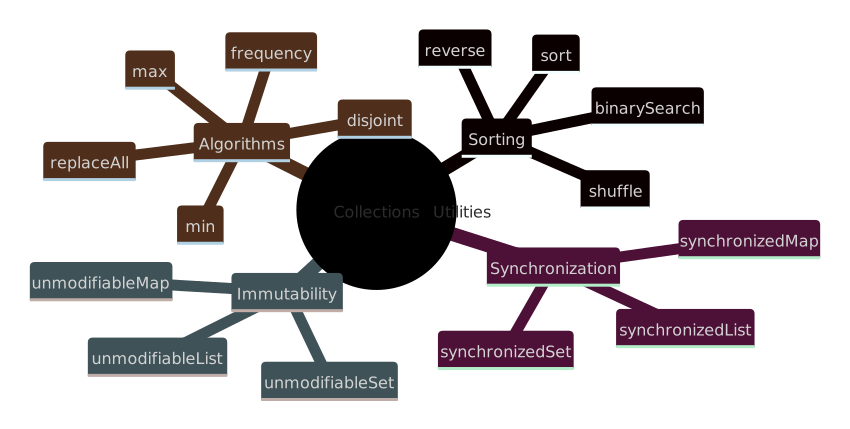
13. Java 8+ Streams with Collections
Section titled “13. Java 8+ Streams with Collections”
14. Memory Usage Comparison
Section titled “14. Memory Usage Comparison”
15. Time Complexity Overview
Section titled “15. Time Complexity Overview”
These dark-themed diagrams provide the same comprehensive overview of the Java Collections Framework with improved visual contrast and modern dark color schemes. The color coding helps differentiate between:
- 🟢 Green: General implementations and efficient operations
- 🔵 Blue: Interface definitions and standard collections
- 🟠 Orange: Thread-safe and synchronized collections
- 🟣 Purple: Utility classes and special operations
- 🟤 Brown: Legacy classes and specific use cases
The dark theme makes the diagrams easier to view in low-light environments and provides better contrast for presentations and documentation.